A Simulation Is a Promise
Moving a millimeter-wave transition from equations to a patented prototype.
A simulation is a promise. A prototype is where you find out whether the promise was true.
An enormous amount of engineering research stops at the promise. Somebody designs a structure, simulates it, optimizes it, and publishes a plot showing that it would work. Nobody builds it. Nobody measures it. The idea goes into a paper, the paper goes into a database, and that is where it lives out its days, cited occasionally by other papers that also stopped at the promise.
The work that ended with a Gold Medal in Geneva did not start out looking any different. It was a transition problem: get a millimeter-wave signal from a standard rectangular waveguide into an air-filled substrate integrated waveguide without losing it on the way. Both structures were well understood. The joint between them was not. The accepted way to design it was to guess a geometry, simulate, adjust, and go again, and to keep going until the plot looked acceptable. Fifty iterations was a normal number.
The idea, if it deserves a grander word, was to stop guessing. Working through the field behaviour at the junction analytically gave a set of design equations that return the transition geometry directly from the target band and the two cross-sections. You state what you need. The equations hand you a structure that works on the first simulation instead of the fiftieth.
Design equations buy more than time. When a geometry falls out of an expression, every term in that expression is a knob you can reason about, and the first question worth asking is which knob the machine shop is most likely to turn without telling you. A parametric sweep cannot answer that. It reports a curve for the shape you asked about and is silent about the shapes you will actually receive. An equation lets you take the derivative, in the plain sense of asking how much the response moves when the channel width moves by the tolerance of a milling cutter, and to choose, before any metal is cut, the version of the structure that cares least. Half of what people call engineering intuition is this habit of asking what breaks first.
The method also travels. Once the fields at one junction had been written down, the same procedure applied to the next one: a coaxial connector into the same air channel, a chip’s output pad into the channel through a board, a channel bending around a corner it was not supposed to bend around. Each is a different geometry and the same discipline, and the discipline is what became the patents. A patent on one shape protects one shape. A patent on a way of arriving at shapes is a different kind of asset, and the difference matters to anyone who plans to build a company on it rather than a paper.
On the day the equations were derived, that looked complete. The plots were beautiful. A paper could have been written that week and the project closed. The question that kept it open was whether the equations would survive a machine shop, because prototypes fail in ways a solver cannot predict, and almost all of those ways are boring. A milled channel comes out a few microns narrow. A bonding layer is thicker than the datasheet says. A connector flange is not quite flat. At 2 GHz none of that matters. At millimeter-wave each boring deviation is a measurable fraction of a wavelength, and the measured curve drifts away from the simulated one for reasons that take weeks to untangle, one suspect at a time.
The first prototypes taught more than the year of simulation before them. The equations held, which was the point. They held because the structure had been chosen from the beginning to tolerate exactly that kind of error, and that tolerance was not luck. From the earliest sketches the questions on the table were not only “does this work in the solver” but “can this be made, can this be measured, is this actually new, and would anyone pay for it.” Those four questions are the difference between a research result and an invention, and a solver cannot answer any of them.
The machine shop has a vocabulary that the simulator does not. Surface roughness, flatness, positional tolerance, the minimum internal radius a cutter can leave in a corner that the drawing shows as sharp. At millimeter-wave, each of those words is a number with a phase attached. A wall that is a fraction of a wavelength rougher than the model assumed adds loss the model never saw. A flange that is not flat leaves a gap that is invisible to the eye and perfectly visible to a 40 GHz signal. Learning that vocabulary, and then designing structures that are forgiving in exactly the places where the shop is not, is the part of the work that no course teaches and every good prototype depends on.
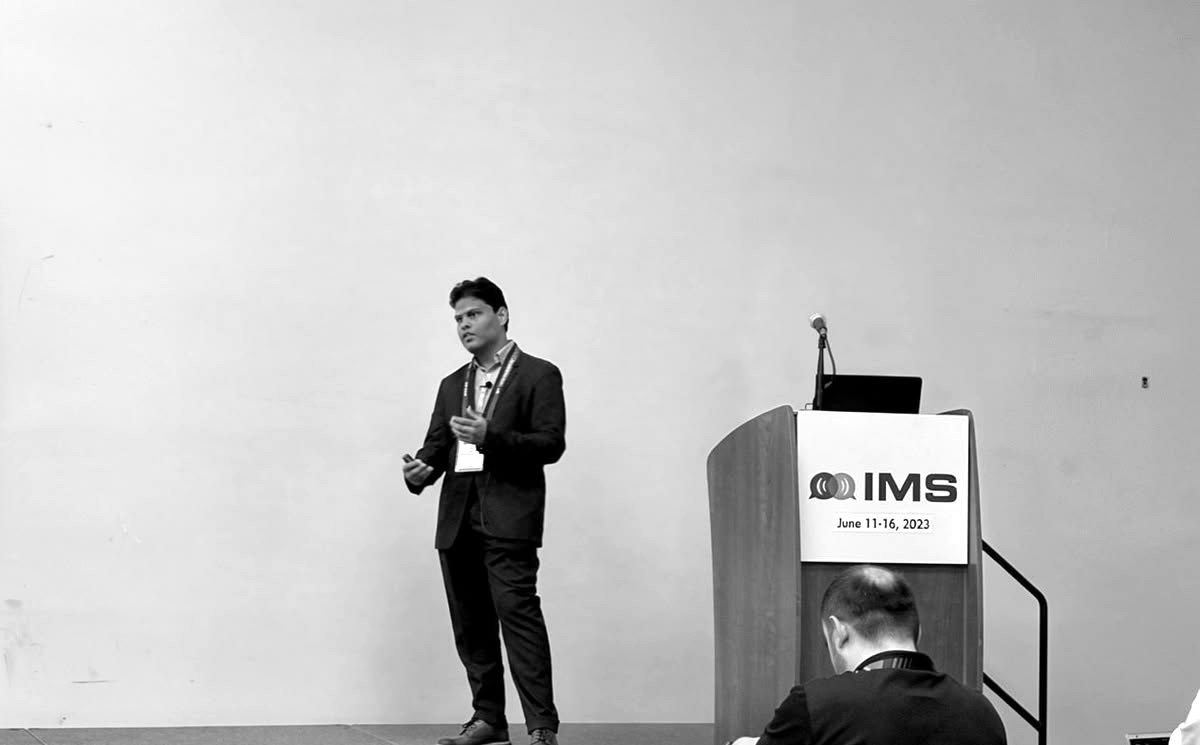
The rest of the trip was longer than the derivation. The measured prototypes went to the IEEE International Microwave Symposium. The design method went to IEEE Access. The apparatus and the method went to the US Patent and Trademark Office and came back as two granted patents. Then the work was one of more than a thousand inventions from over forty countries on the floor in Geneva, and it came home with a Gold Medal.
None of those steps is glamorous, and every one of them is a place where good ideas routinely die. A patent means office actions and arguments with an examiner. A prototype means budgets, vendors and lead times. An exhibition means explaining a waveguide transition to people who have never heard of a waveguide, and finding out in the first thirty seconds whether you actually understand it yourself. A researcher who wants the work to matter outside a citation count has to be willing to do all of it, or to find people who will.
The patent process deserves a word of its own, because engineers tend to imagine it as paperwork and it is closer to a second peer review with higher stakes. An examiner’s job is to find the prior art that makes your claim unoriginal, and a good examiner is very good at it. The office actions that come back are arguments, and answering them means understanding not only what you built but precisely what is new about it and where the boundary of that novelty lies. Several of the design choices in the final transition were sharpened by having to defend them in that exchange. It is an uncomfortable process, and it made the invention better.
The exhibition floor is the opposite test. In Geneva the people stopping at the stand were investors, distributors, other inventors, and members of the public who had never heard the word waveguide. There is no slide deck for that. You have thirty seconds to say what the thing does and why anyone should care, and if you cannot, you have learned something about your own understanding. Engineers underrate that skill because it looks like marketing. It is closer to the discipline of a good abstract: if the idea cannot survive being stated simply, it may not be as clear as the plots suggest.
The lesson travels well beyond RF. An invention that nobody funds, protects or builds is a cool idea in a folder. You do not have to become a lawyer or a financier to carry an idea from the simulator to the world, but you do need enough literacy in funding, intellectual property and manufacturing to know which door to knock on next, and enough stubbornness to keep knocking after the plots stop being enough.
There is a last step that even the medal does not cover, and it is the one most research never reaches: turning the prototype into a product someone else can buy, mount, and forget about. That means tolerancing for a factory rather than a machine shop, a bill of materials somebody will sign, a test that takes seconds rather than a week, and documentation a technician can follow at two in the morning. None of it is research. All of it is engineering, and the field would be healthier if it treated that distance as part of the work rather than as somebody else’s problem.
Simulations are where the work starts. The folder is not where it has to end.